
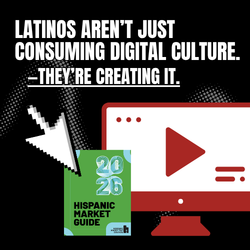
Latinos Aren’t Just Consuming Digital Culture. They’re Creating It.
October 14, 2026
For years, marketers have talked about Hispanic audiences as highly engaged digital consumers. But that description no longer goes far enough.
Latinos are not simply watching, scrolling and shopping. They are creating content, curating communities, adopting new tools and building the digital ecosystems that increasingly shape mainstream culture.
As the 2026 Hispanic Market Guide reveals, this evolution grew partly out of necessity. Hispanic audiences moved away from traditional network television earlier than many other consumers, driven in part by a lack of meaningful representation in legacy content. Rather than wait for traditional media to catch up, they found—and built—alternatives across social media, streaming services and creator platforms.
What began as a response to being overlooked has become a powerful engine of cultural and commercial influence.
Today, Hispanic audiences use technology for far more than entertainment. Digital platforms are spaces for creative expression, education, communication and economic opportunity. Latinos are choosing the voices they follow, assembling culturally relevant feeds and turning personal influence into businesses, communities and purchasing power.
The numbers make that influence hard to miss. More than half of Hispanics say they want greater representation on social media, including 63% of Spanish-dominant Hispanics. They are also 115% more likely than the total U.S. population to use CapCut, a video-editing app that helps creators produce and share their own content, and 15% more likely to use Linktree to organize and monetize their digital presence.
They are embracing emerging technologies, too. Hispanics are 56% more likely to use artificial intelligence platforms such as ChatGPT—a sign that this audience is not waiting on the sidelines as the next generation of digital tools takes hold.
That activity does not stop at content creation. It converts into commerce.
Thirty-five percent of Hispanics frequently purchase products they see advertised on social media, while 29% say shoppable ads are interesting and make buying more convenient. Among Hispanic women, 80% report regularly purchasing products based on influencer recommendations.
These are not passive impressions. They are signals of trust, intent and action.
Yet brand investment remains badly out of step with audience behavior. Despite the community’s heavy digital engagement, only 0.92% of digital advertising spending goes to Spanish-language websites. Across major categories—including restaurants, streaming services, online retail, telecommunications and movies—spending on Spanish-language digital platforms is only a fraction of the investment directed to English-language sites.
That imbalance represents more than an equity problem. It is a business inefficiency.
Marketers are investing around an audience that is already creating trends, influencing purchasing decisions and defining how digital platforms are used. The opportunity is not simply to place more advertising in front of Hispanic consumers. It is to build strategies around how they actually participate online.
That means partnering with creators early enough to help shape the idea—not bringing them in at the end to distribute it. It means understanding the communities, conversations and platforms where cultural relevance is being built. It also means recognizing that language still matters. A bilingual or English-dominant consumer may move fluidly between cultural spaces, but that does not make Spanish-language platforms—or culturally specific content—less valuable.
Most importantly, brands need to stop viewing creators as another media channel. Creators are cultural translators, community builders and entrepreneurs. They understand the nuances that make content feel native rather than inserted. They know when a trend genuinely fits a brand—and when participation will feel forced.
The 2026 Hispanic Market Guide leaves marketers with a clear challenge: Shift investment to where the attention, creativity and influence already are.
Hispanic audiences are not waiting to be represented by the digital ecosystem. They are building it themselves.
The only question is whether brands will catch up.